 EN
EN



Limpet teeth set new strength record

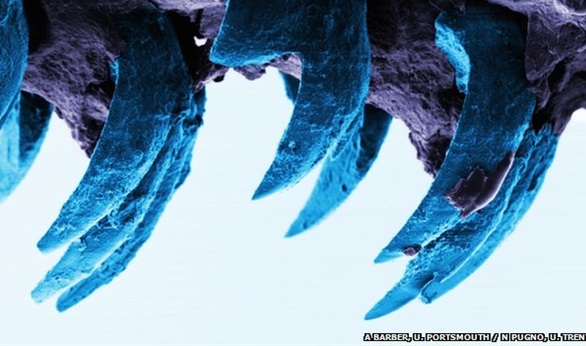
Engineers in the UK have found that limpets' teeth consist of the strongest biological material ever tested.
Limpets use a tongue bristling with tiny teeth to scrape food off rocks and into their mouths, often swallowing particles of rock in the process.
The teeth are made of a mineral-protein composite, which the researchers tested in tiny fragments in the laboratory.
They found it was stronger than spider silk, as well as all but the very strongest of man-made materials.
The findings, published in the Royal Society's journal Interface, suggest that the secret to the material's strength is the thinness of its tightly packed mineral fibres - a discovery that could help improve the man-made composites used to build aircraft, cars and boats, as well as dental fillings.
"Biology is a great source of inspiration as an engineer," said the study's lead author Prof Asa Barber, of the University of Portsmouth.
"These teeth are made up of very small fibres, put together in a particular way - and we should be thinking about making our own structures following the same design principles."
'Better than Kevlar'
Those fibres, consisting of an iron-based mineral called goethite, are laced through a protein base in much the same way as carbon fibres can be used to strengthen plastic.
The teeth themselves are less than a millimetre long, but Prof Barber and his colleagues ground 10 of them into a minuscule dog-bone shape in order to precisely measure the composite's tensile strength: the amount of force it can withstand before breaking.
The middle part of these samples was more than 100 times thinner than a human hair.
With either end glued to specialised levers inside a device called an atomic force microscope, the engineers applied a pulling force to each of these milled tooth samples until they snapped.
The strength they calculated for the tooth material was, on average, about five gigapascals (GPa) - some five times greater than most spider silk.
This sets a new record for biology, Prof Barber said, even when his team considered the most unusual spiders.
"People are always trying to find the next strongest thing, but spider silk has been the winner for quite a few years now," he told the BBC. "So we were quite happy that the limpet teeth exceeded that.
"One of my colleagues on the paper, from Italy, found some exotic spider silk that was about 4.5GPa, and we measured about 5GPa."
This measurement is about the same as the pressure needed to turn carbon into diamond beneath the Earth's crust. Alternatively, as Prof Barber explained, it can be compared to a single string of spaghetti holding up 3,000 half-kilogram bags of sugar.
'Bulldozers of the shore'
In terms of man-made materials, the limpet tooth is stronger than Kevlar fibres and almost as good as the best high-performance carbon fibre materials.
The key, Prof Barber said, is that its strength-giving mineral fibres are very thin - the ideal width, in fact, for avoiding holes or flaws that would weaken the structure.
This is something that engineers could learn from.