 EN
EN


Netanyahu to blame for security failures, worsened relationship with US, former Mossad Chief says

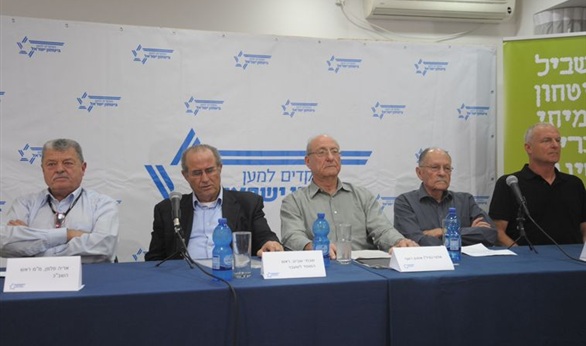
Prime Minister Benjamin Netanyahu is responsible for failed policies on Hamas and the Iranian nuclear program and has poisoned Israel’s relationship with the United States, former Mossad Chief Shabtai Shavit said Wednesday.
Shavit was one of five speakers at a press conference held in Tel Aviv by the Commanders for Israel's Security, a group of 180 former senior commanders from the IDF, Mossad, Shin Bet and Israel Police, which describes itself as a non-partisan movement devoted to promoting a regional initiative to bring peace between Israel and the Palestinians and normalize Israel’s relations with the Arab World.
In addition to Shavit, the press conference featured Brig. Gen. (ret.) Asher Levy, Maj.-Gen. (res.) Amnon Reshef, Brig. Gen. (ret.) Giora Inbar and Aryeh Felman, former division head and deputy director of the Shin Bet (Israel Security Agency).
“No one else is responsible for the failures in facing Hamas, the Iranian nuclear program. No one else is responsible for turning the United States from an ally into an enemy. We are asking you, where is your sense of responsibility?”, Shavit said
Shavit, who served as Director of the Mossad from 1989-1996, also accused Netanyahu of being bad for the security of Israel and that, in his his personal opinion, Netanyahu’s handling of the Iranian nuclear issue has been “one big mistake which has caused damage to the state of Israel and I am certain will cause damage in the future as well.”
Reshef claimed that Netanyahu "suffers from the sort of diplomatic blindness that we saw before the Yom Kippur War."
Reshef said, "Unfortunately, we paid a heavy price in the Yom Kippur War, a price that could have been prevented if we would have understood what [the Egyptians] wanted. In the end, we ceded every millimeter of land, but lost valuable people. Unlike what the prime minister and his people say, the Israeli public believes in a diplomatic solution with the moderate pragmatic Arab states, into which the Palestinian issue can be integrated. The IDF can defend Israel on any borders that are established by the government."
Shavit rejected claims that the former officials are no longer part of the security apparatus and therefore do not have the requisite knowledge of the situation to make such claims. "Israel is known as a small country, a place in which everyone knows each other. Israel is a place in which many people serve in the army. Information flies in all different directions. If someone accuses us of not knowing, he's either evil or an idiot."
Inbar said that Netanyahu had failed to turn the military achievements of Operation Protective Edge, which had a great human cost, into a diplomatic achievement that could ensure security and peace to Israel for the next ten years on the Gaza front. "I expected him to come with a big plan that would get into the depths of the problem and translate into the demilitarization of Gaza and into the rehabilitation of Gaza and the lives of those who live there."
Levy said that after Operation Protective Edge there had been a great opportunity to unite the Arab states in a coalition with Europe and even far eastern states. "They all expressed a willingness to stop the spread of radical Islam and to solve the problems in Gaza."
"Netanyahu's central problem is that he does not initiate, he only reacts all the time...He claims that he's Churchill, but even Churchill knew that without the United States he could not do it." .
Shavit discussed the January air strike in Syria widely attributed to Israel in which 12 were killed, including Jihad Moughniyeh, the son of former Hezbollah military commander Imad Moughniyeh. "The assassination of Moughniyeh the son was nonsense. I experienced Moughniyeh the father, and I know the differeence between the two. Moughniyeh the father was behind the terror attack in Argentina. He was a man of great stature, I can say now that he's gone. But he was an enemy whose abilities had to be appreciated. His son was not like this. The decision to assassinate him was a mistake."
"I believe that the security of Israel is not dependent solely on military prowess, but also on diplomacy... Israel's diplomacy is one big failure. Anti-Semitism has risen almost to the level of the 1940s. They hate us, Europe loathes us. We are losing the campuses in the United States. The next generation of the American leadership grows up on these campuses and we are losing them. I blame this failure on our diplomatic planning and implementation. Who is responsible for this. Completely the prime minister," he added.
In early March, the group called on Netanyahu to cancel his speech last week to the US Congress and warned that his security and diplomacy policies were destroying Israel’s alliance with the US, harming the country’s deterrence and helping Iran get closer to obtaining nuclear weapons.
The group's comments come just days after storied former Mossad Chief Meir Dagan, who served from 2002-2011, slammed the prime minister at a major anti-Netanyahu rally in Tel Aviv. Dagan said that while Israel is surrounded by enemies he is more frightened by Israel’s leadership and that they have a “lack of vision and loss of direction." The former Mossad chief added, " I am frightened by the hesitation and the stagnation. And I am frightened, above all else, from a crisis in leadership. It is the worst crisis that Israel has seen to this day.”
A day earlier, Channel 2 aired an interview with Dagan in which he called claims Netanyahu made in his speech before the US Congress last week “bullshit”.