 EN
EN


Step Pyramid of Djoser

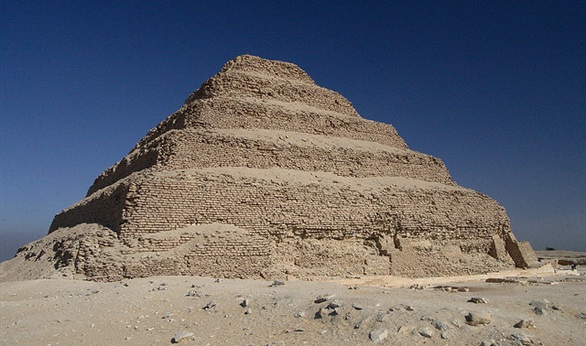
The Step Pyramid of Djoser at the Saqqara necropolis was the very first pyramid built by the ancient Egyptians. It was constructed during the 27th century BC for the burial of Pharaoh Djoser by his Vizier Imhotep. The ancient monument began as a traditional, flat-roofed mastaba but by the end of Djoser’s reign it had risen to a six stepped layer Pyramid and stood 204 feet (62 meters) high. As in earlier mastaba tombs, the burial chambers of the Step Pyramid are underground, hidden in a maze of tunnels.
Djoser’s Pyramid draws ideas from several precedents. The most relevant precedent is found at Saqqara mastaba 3038. The substructure lay in a 4m deep rectangular pit, and had mudbrick walls rising to 6 m. Three sides were extended and built out to create eight shallow steps rising at an angle of 49°. This would have been an elongated step pyramid if the remaining side had not been left uncovered. In another parallel to Djoser’s complex, to complete this mastaba complex a niched enclosure wall was erected.
Djoser was the first or second king of the 3rd Dynasty (ca. 2667 to 2648 BC) of the Egyptian Old Kingdom (ca. 2686 to 2125 BC). He is believed to have ruled for 19 years or, if the 19 years were biennial taxation years, 38 years. He reigned long enough to allow the grandiose plan for his pyramid to be realized in his lifetime.